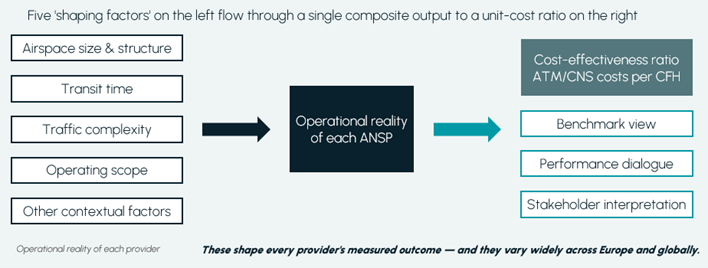
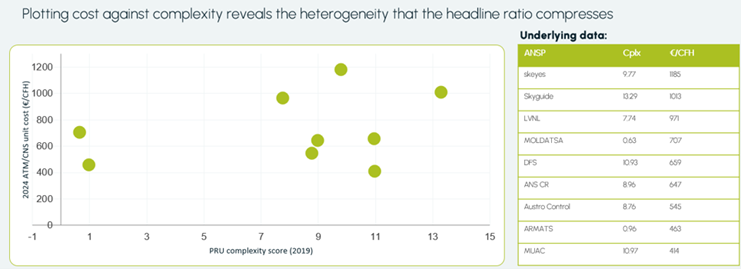
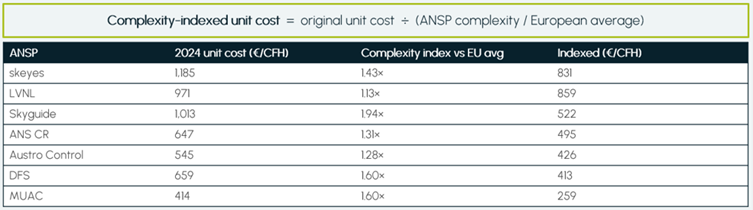
Cluster, contextualise, complement, calibrate — four habits of interpretation that make air navigation benchmarking more useful for decision-making, for regulators, providers and airspace users.
Egis Director Dr Juraj Jirků presented at Airspace World 2026, in the CANSO Theatre session on policy, regulation and governance. Drawing on that talk, this article looks at how operational context can make cost-effectiveness benchmarking of air navigation service providers (ANSPs) more useful.
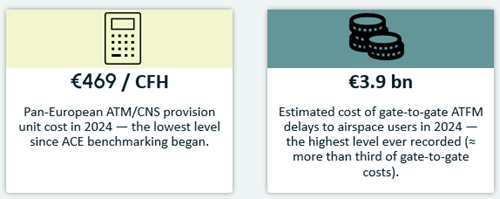
Consider two figures from the same year. In 2024, the pan-European (preliminary) unit cost of ATM/CNS provision fell to €469 per composite flight-hour (CFH) in real terms — the lowest level since the EUROCONTROL ATM Cost-Effectiveness (ACE) benchmarking exercise began. At the system level, that is real progress and worth recognising. In the same year, the estimated cost of gate-to-gate air traffic flow management delays to airspace users reached €3.9 billion, the highest figure ever recorded, and equivalent to more than a third of total ATM/CNS provision costs. Viewed from the airline cockpit, 2024 was the worst delay year on record.
Both numbers are real and officially recorded. The headline of "lowest unit cost" only holds if you ignore the other side of the ledger. The benchmarking question, then, is not which figure is right; it is how we read them together. And these are European numbers; globally the picture is even more varied. The moment to ask this question is a good one: the fourth Reference Period (RP4) of the Single European Sky Performance Scheme began on 1 January 2025, a new Performance Review Board took office in September 2025, and the European ATM community is already discussing how the framework should evolve for RP5 and beyond.