As cities worldwide face rapid urbanisation and rising climate pressures, the opportunity to create sustainable, inclusive, and prosperous urban mobility systems has never been clearer. Transit-Oriented Development (TOD) places rail infrastructure at the centre of that opportunity, transforming stations into catalysts for vibrant, resilient urban districts.
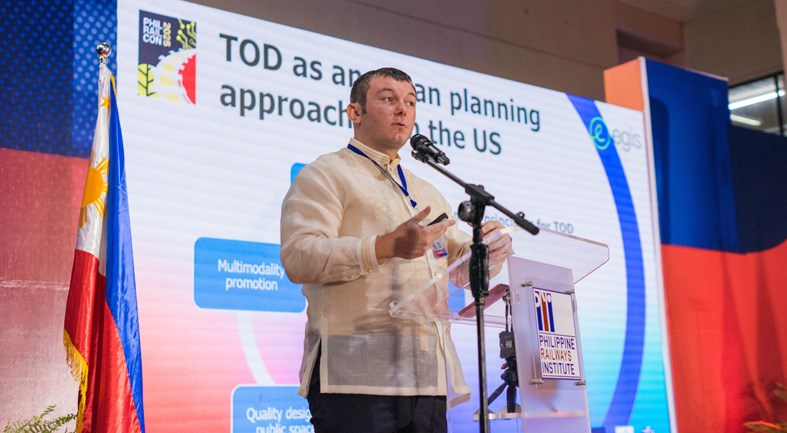
At the 3rd Philippine Railway Conference 2025, Valentin Bouzigues, Business Development & Tender Manager for the Philippines, showed how TOD reaches its fullest potential when deliberately combined with a broader Sustainable Urban Mobility Plan (SUMP) framework, an approach that is already delivering results across Asia and Europe.
The enduring power of TOD
Born in the United States as a response to car-dependent sprawl, TOD promotes compact, mixed-use districts around high-capacity public transport. Its five core principles, including mixed land uses, social equity, active mobility, quality public spaces, and multimodality, are consistently delivering better quality of life, higher returns on transport investment, environmental sustainability, and lasting economic vitality.
Why SUMP is the perfect city-wide partner
SUMP elevates station-area excellence into system-wide transformation. By design, it is multimodal, participatory, and climate-conscious, seamlessly connecting formal and informal modes while enabling continuous improvement. TOD brings intensity to the node; SUMP brings coherence to the network.
Egis: blending global experience with local reality
With decades of leadership in both TOD and SUMP projects, from Dubai, Makkah and Paris to Kocaeli, Surabaya, Kurunegala and Arequipa, and a presence in the Philippines since 1968, Egis is uniquely equipped to turn proven concepts into tangible outcomes.
Three projects that demonstrate the model in action
Hanoi Metro Line 5: precision prioritisation, exceptional returns
Overlaying the 3V methodology with multi-hazard mapping revealed that a handful of stations capture most of the development value and climate risk. Focusing resilient design (elevated equipment, floodable concourses, nature-based solutions) on these priority locations delivers outstanding benefit-cost ratios while keeping the full line affordable.
Grand Paris Express: an ambitious project promoting regional development
The addition of 200 km of automated metro lines and 68 new stations connects underserved suburban areas to major business districts, educational centres, airports, and high-speed rail terminals, eliminating the need for travel through central Paris. This dramatically reduces commute times for around 3 million daily users and enhances access to jobs, services, and education. The project emphasises Transit-Oriented Development (TOD), ensuring stations are fully accessible, designed for climate resilience, and serve as gateways for connections.
The Philippines – A rare convergence of scale and timing
To promote resilient TOD alongside SUMP in the Philippines, rail agencies and LGUs should adopt integrated policy strategies. This includes requiring climate risk assessments in TOD plans, offering incentives for mixed-income, flood-adapted developments, and ensuring stronger alignment between transport, housing, and climate planning. Institutional collaboration is essential; TOD principles must be embedded early in MRT project planning to maximise synergies between infrastructure, land use, and sustainability goals. These measures will help create inclusive, climate-resilient communities while optimising the long-term value of rail investments.
The framework that turns vision into reality
The framework rests on four pillars that can be applied:
1. Robust, top-down alignment of urban and mobility strategies
2. Translation of vision into enforceable regulation that prevents real-estate-only outcomes
3. Institutionalised resilience measures — flood-adapted stations, affordable-housing quotas, inclusive first/last-mile networks
4. Smart policy tools such as value-capture financing and mandatory TOD-readiness assessments
TOD is the seed; SUMP is the rain that helps it grow. Together, they ignite hybrid benefits that no single approach can match — resilient, decarbonised, and equitable mobility systems that make every kilometre of new rail a multi-decade, city-shaping investment.
*Astari Febriani and Amalia Almira contributed to the drafting of the paper presented by Valentin