
Traditionally, MEP coordination has been organised around a familiar cycle. Services are laid out, clashes are identified, conflicts are resolved, and the process repeats until the model can be built. This approach has improved baseline quality and reduced obvious errors. Yet it remains inherently reactive, and in today’s delivery environment, reactivity carries financial, programme and reputational consequences.
Nowhere is this more apparent than in the Middle East, where fast-track programmes and late-stage change are not exceptions but routine delivery conditions. Architectural revisions, regulatory changes, and equipment upgrades frequently arrive after coordination effort has already been expended. In that context, workflows built around repeated clash detection can compound the impact of change, increasing rework and compressing decision time.
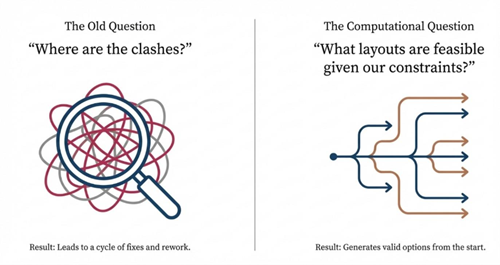
Reframing coordination from a reactive search for errors to a proactive study of feasibility.
Clash detection remains essential for quality assurance, but it is a fragile primary method under change, as it depends on repeated correction cycles. Many issues are downstream symptoms, visible in geometry but rooted in unresolved priorities. Reports can locate the conflict, yet they rarely explain which requirement should prevail or why. Decisions then depend on negotiation and experience, increasing variability and slowing delivery.
In practice, coordination failures tend to originate earlier than the moment they are detected, so by the time a clash appears in the model, the opportunity to resolve it cheaply has already passed. The industry’s challenge, then, is how to avoid creating clashes in the first place.
Coordination as a Design Decision
A shift is now emerging through computational design that reframes coordination as an early-stage decision process rather than a late-stage verification exercise. The central question changes from “Where are the clashes?” to “Which layouts are feasible given our constraints, and what trade-offs do they imply?”
As a result, traditional coordination treats geometry as the primary output and rules as something to be checked afterwards. Computational coordination reverses that relationship by making constraints, priorities, and constructability explicit and computable. Doing so, geometry becomes a consequence of those decisions rather than their starting point.
Consequently, when constraints such as clearance, access, hierarchy and constructability are embedded at the point of generation, invalid options are never produced. When inputs change, layouts do not need to be manually redrawn and revalidated; they can be regenerated within the same rule set. Most importantly, the reasoning behind a layout is repeatable and open to scrutiny.
This is the foundation of what is increasingly described as clash avoidance. Validation does not disappear; it moves upstream. Engineers are presented with a bounded set of feasible options and asked to exercise judgement in selecting the most appropriate one.
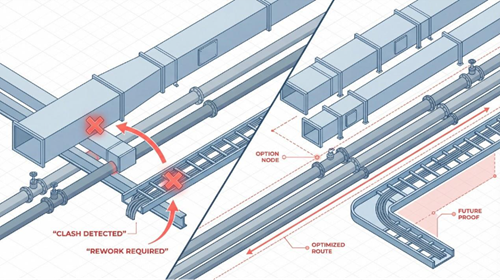
The effect of this reordering is most visible under programme pressure; these fast-track environments require speed, achieved by overlapping stages and accepting a greater exposure to risk. Computational coordination offers a more resilient form of speed, in which iteration becomes cheaper and more predictable, and where progress is less dependent on heroic individual effort. This matters commercially, as much as it does technically, translating directly into programme certainty and cost control.
Strengthening, Not Replacing, Engineering Judgement
Computational design should not be mischaracterised as a substitute for engineering judgement. Its purpose is the opposite: it strengthens judgement by making assumptions explicit and decision logic visible. In complex, multi-stakeholder environments, this improves alignment and reduces friction, particularly when design intent must be communicated and defended to clients, contractors, or authorities
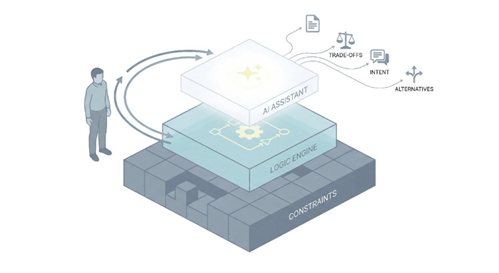 .
.
As artificial intelligence becomes more accessible, its role in coordination will expand, but its effectiveness will depend entirely on the clarity of the underlying logic. AI can accelerate the translation of intent into action, clarify trade-offs and reduce the latency between change and response. Without an explicit constraint framework, it risks producing options that appear coherent while failing fundamental engineering requirements. Used correctly, however, it becomes an amplifier of disciplined engineering thinking.
The shift is not whether coordination happens, but where it is anchored. When constraints and priorities are made explicit early, coordination becomes a decision system guiding layout generation. Clash detection then returns to its proper role as audit rather than method. In the Middle East, this also strengthens technical alignment across complex approval and delivery interfaces. Traceable decisions reduce avoidable review cycles and coordination rework, improving the reliability of design to construction handover, particularly where prefabrication is used.


