
Burton Mangharam, Programme Director at Egis, joined the panel discussion on the next decade of Philippine road, bridge and tunnel development at the 6th Philippine Roads, Bridges & Tunnels Summit, City of Dreams Manila, 19–20 August. Ahead of the summit, he recorded this perspective on what the next decade will demand.
Listen to the full recording
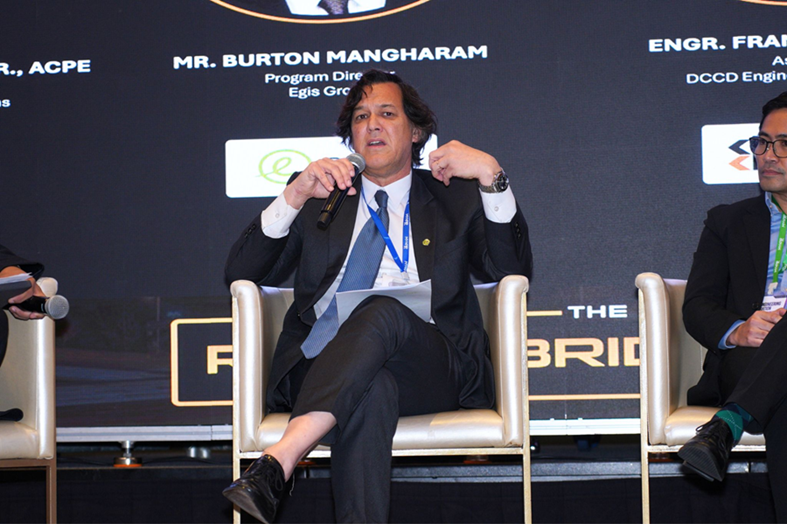
"The next decade of Philippine infrastructure will be defined not simply by how much we build, but by how intelligently we design, deliver, operate and maintain it."
That is Burton's proposition, and the Philippines is well-positioned to put it into practice. The country is rapidly expanding its road, rail and tunnelling capacity while confronting climate change, congestion, urbanisation and growing maintenance pressures all at once.
What follows is driven by three key forces: technology, people and evolving market demands.
Technology: from drawings to information
The digital evolution is clear: BIM → Common Data Environments (CDEs) → 4D and 5D modelling → digital twins → AI-enabled operations. The Philippines is currently at the BIM stage and in the middle of this digital transition. But the true purpose of these tools is often overlooked:
"The objective is not to create beautiful drawings and models. The objective is to create reliable information that remains useful throughout the life of the asset."
AI is already being applied at every stage of infrastructure delivery: design optimisation and automated checking during design; progress monitoring, image recognition and schedule risk prediction on site; and predictive maintenance, bridge inspection and tunnel monitoring during operations.
"AI will not replace the engineer. But the engineer who can use AI, data and digital tools will increasingly outperform the engineer who cannot."
The key caveat: these tools must always be used with sound engineering judgement, validation and accountability.
Meanwhile, drones, LiDAR and reality capture are already being used across the Philippines for corridor mapping, bridge inspections, landslide monitoring and disaster assessment. Their value lies not just in speed, but in better information, safer inspections and earlier detection of potential problems.
Infrastructure assets are also becoming smarter, with bridges equipped for structural health monitoring, roads supported by intelligent traffic management systems, and tunnels featuring fire detection and real-time operational control.
"The tunnel is no longer simply a hole through a mountain or under the sea. It is a complex operational system."
People: the real bottleneck
The biggest challenge isn't technology – it's the ability of people to use it effectively.
The engineer of the future must be digitally literate, but does not need to be a programmer. They must be fluent in BIM, data and AI tools, while still mastering traditional engineering skills such as risk management, contracts and stakeholder engagement. Technology does not replace the fundamentals – it helps engineers work better and make smarter decisions.
Beyond technical skills, there are equally important human strengths: leadership, communication, commercial awareness and sound decision-making. The shift is from being a competent engineer to becoming a capable programme leader.
For international consultants and contractors, one measure of success matters most:
"The real measure of success is not how much expertise we import. It's how much expertise we leave behind."
Knowledge transfer must be a core part of project delivery, not an afterthought. This requires close collaboration between universities, professional institutions, industry and government to ensure that engineering education keeps pace with evolving market demands.
Market: from lowest cost to whole-life value
Historically, clients have focused on scope, quality, cost and programme. In the next decade, they will also expect safety, resilience, sustainability, digital capability and whole-life value.
The priority is shifting from finding the cheapest way to build an asset to finding the cheapest way to own and maintain it over its lifetime. Procurement must therefore consider durability, maintainability and lifecycle performance, not just initial construction cost.
Resilience must become standard practice. In the Philippines, this means designing for typhoons, flooding, earthquakes and extreme rainfall as a matter of course, not as special considerations.
Sustainability is also becoming a commercial priority, with carbon, materials, energy use and recyclability playing a growing role in project decision-making.
Integration will become the norm. For example, a rail hub is no longer just a station – it must be designed to connect seamlessly with metro lines, buses, passengers and the surrounding city.
More broadly, the focus is shifting from individual projects to programmes, networks and their impact on the wider economy. The value of a road lies not in the road itself, but in the connectivity, mobility and productivity it enables.
"The question will no longer be, 'Can we build it?' The question will be, 'Can we build it – and operate and maintain it efficiently for the next 20 to 50 years?'"
Bringing it together
Technology: The real transformation is not engineering being replaced by technology, but data making engineering more informed, predictive and better integrated.
People: We must develop the engineer of the future without losing the core fundamentals that have always defined great engineers.
Market: We must shift from buying projects to buying outcomes – from asking, "What's the cost now?" to asking, "What's the value over the long term?"
The biggest change over the next decade will not be any single technology. It will be how we bring technology, people and infrastructure together. For the Philippines, that means delivering digitally enabled, resilient and sustainable assets – and equipping engineers to operate and maintain them for decades to come.


